The ceiling light is the one fixture every living room has, and the one most of us never think about. Yet it sets the mood of the whole room: the wrong one makes a space feel flat, glaring or cramped, while the right one makes it look bigger, warmer and more finished. Below are 12 living room ceiling lighting ideas for every ceiling height and budget, plus the simple sizing rules designers use so your new light looks right the first time.
Quick guide: which ceiling light suits your living room?
| Ceiling height | Best options |
|---|---|
| Under 8 ft (2.4 m) | Flush mounts, recessed lights, slim LED panels, track lighting |
| 8–9 ft (2.4–2.7 m) | Semi-flush fixtures, low-profile chandeliers, recessed lights, ceiling fans with a light kit |
| 9 ft (2.7 m) and higher | Chandeliers, pendants and pendant clusters, tray or cove lighting |
| Sloped or vaulted | Pendants or chandeliers with a sloped-ceiling adapter, adjustable track, angled recessed trims |
1. A statement chandelier
Nothing turns a living room into a destination faster than a chandelier. Crystal styles suit classic and glamorous rooms, while modern versions in brass, black metal, glass globes or paper look just as good above a low modular sofa. Hang it centered on the seating area rather than the room if the two don’t line up; the light should belong to the place where people actually sit.
Sizing tip: add the length and width of the room in feet, and use that number in inches as the chandelier’s diameter. A 14 x 16 ft living room suits a fixture roughly 30 inches across. Keep the bottom at least 7 ft (2.1 m) above the floor anywhere people walk underneath it.

2. Pendant lights
Pendants hang from a single cord, rod or chain and come in every style, from big dome shades to small glass globes. In a living room, one large pendant can replace a chandelier, while two or three smaller ones work well over a reading corner, a dining area in an open-plan room or either side of a sofa. Choose shades that point light downwards for a cozy pool of light, or opal glass that glows in every direction for general lighting.
For a dining table in an open living space, hang pendants 30–36 inches (75–90 cm) above the tabletop so they light the table without blocking the view across it.

3. A cluster of pendants or bare bulbs
Grouping several pendants at different heights creates a sculptural, café-style feature, especially over a coffee table or in a double-height corner. Mixing bare filament bulbs with simple shades or even hanging planters gives a relaxed, industrial-bohemian look. Use warm, dimmable bulbs: a cluster of bright cool-white bulbs quickly feels like a shop window.

4. Flush mounts for low ceilings
Flush mounts sit directly against the ceiling, so they are the go-to choice for rooms under 8 ft. They have come a long way from the plain “boob light”: today you’ll find woven rattan, linen drums, ribbed glass and slim LED discs that look designed rather than default. In a larger room, two matching flush mounts spaced evenly give better coverage than one big one in the middle.
5. Semi-flush fixtures
Semi-flush lights drop a few inches from the ceiling on a short stem, which lets light bounce off the ceiling as well as shine down. That makes them softer and more flattering than a flush mount, and they suit standard 8–9 ft ceilings perfectly. A wide fabric drum shade, like the one below, is a classic choice that works in traditional and modern rooms alike.

6. Recessed lights (downlights)
Recessed lights are set into the ceiling, so they disappear and leave the ceiling clean. They are ideal for even, general light in modern rooms and low ceilings, but on their own they can feel flat, like an office. The fix is to put them on a dimmer, keep them away from the centre of the room and use them to wash walls, artwork and shelves instead.
Spacing tip: divide your ceiling height by two to get the spacing between lights. With an 8 ft ceiling, place them about 4 ft apart and around 2–3 ft from the walls. Warm-dim LED downlights, which get warmer as you dim them, give the most relaxed evening light.

7. Cove and indirect LED lighting
Cove lighting hides LED strips in a recess or behind a ledge around the edge of the ceiling, so you see the glow but not the source. Because the light bounces off the ceiling, the room feels taller and wider, and there is no glare at all. It is perfect as soft background light for watching TV. Many LED strips can also change color, though warm white is the version that never gets tiring.
8. Light up a tray or coffered ceiling
If your living room has a tray (raised centre) or coffered ceiling, make it part of the lighting. LED strips tucked into the step of a tray ceiling outline its shape, and a chandelier or pendant in the centre completes the look. It is one of the most effective ways to make an ordinary room feel high-end.

9. Track lighting and linear LED
Track lighting runs several adjustable spotlights from one power point, which makes it a great choice if you can’t add new wiring. You can aim each head at artwork, a reading chair or a bookcase. Modern versions are slim, magnetic and come in black, white or brass. Linear LED profiles, long glowing lines set into or hung from the ceiling, give a sleek, architectural look that suits lofts and minimalist rooms.

10. Lighting a sloped or vaulted ceiling
Vaulted and attic ceilings look dramatic but are tricky to light. Pendants and chandeliers need a sloped-ceiling adapter so they hang straight, and recessed lights need angled trims so they point down rather than at the wall. Uplighting the beams or the slope with cove LEDs or wall lights shows off the height, while a few pendants bring the light back down to a cozy level.

11. A ceiling fan with a light
In warm climates a ceiling fan is a must, and a good fan-light combines two jobs in one fixture. Look for designs with an integrated, dimmable LED and wood or matte black blades, which look far better than the old brass-and-glass models. Keep the blades at least 7 ft above the floor, and choose a 50–54 inch fan for an average living room of around 225–400 sq ft.
12. No ceiling wiring? Fake it
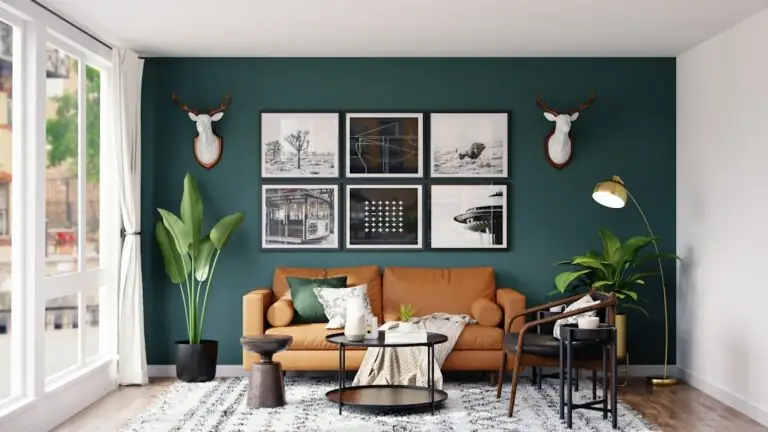
Renters and anyone with no ceiling light at all still have options. An arc floor lamp reaches over the sofa like a pendant, a plug-in “swag” pendant hangs from a ceiling hook and runs its cord to a wall socket, and rechargeable or smart bulbs make it easy to control everything from your phone. Painting the ceiling a soft color, or a bold one like the plum above, also changes how light feels in the room.

Layer your living room lighting
Even the best ceiling light shouldn’t do all the work. Lighting designers use three layers, and a living room needs all of them:
- Ambient light: the overall light from your ceiling fixture, recessed lights or cove lighting.
- Task light: focused light for reading or hobbies, from floor lamps, table lamps and adjustable wall lights.
- Accent light: light that shows off what you love, such as picture lights, shelf lighting or a spotlight on a plant.
Put each layer on a separate switch or a dimmer, and aim for light at three heights: ceiling, eye level and low. That is the secret behind rooms that look warm in the evening rather than lit like a stage.

Choosing bulbs: brightness and color
- Brightness: plan for roughly 10–20 lumens per square foot of living room, so about 1,500–3,000 lumens in total for a 150 sq ft room, shared across all your lights.
- Color temperature: 2700K–3000K is the warm, relaxing range for living rooms. Avoid 4000K and above, which looks cold in the evening.
- Color accuracy: choose bulbs with a CRI of 90 or more so skin tones, wood and paint colors look natural.
- Dimmers: check that your LED bulbs or fixtures are marked dimmable and compatible with your dimmer switch to avoid flicker.
Common ceiling lighting mistakes
- One central light and nothing else. It creates harsh shadows and a flat room. Add lamps.
- A fixture that is too small. A tiny light in a big room looks like an afterthought. Use the length-plus-width rule.
- Hanging it too low or too high. Keep 7 ft of clearance where people walk; in high rooms, lower it by about 3 inches for each extra foot of ceiling height.
- Cool white bulbs. They make a living room feel like an office.
- A grid of downlights everywhere. Fewer, well-placed lights that wash the walls look far better than rows of holes.
Planning a bigger update? See our guides to living room ideas and small living room design ideas on a budget, or find out what’s coming next in our home decor trends 2027 and Color of the Year 2027 roundups.
Frequently asked questions
What is the best ceiling light for a living room?
It depends on your ceiling height. Under 8 ft, choose a flush mount or recessed lights; at 8–9 ft, a semi-flush fixture or low chandelier; above 9 ft, a chandelier, pendant or cluster. Whatever you choose, add floor and table lamps so the ceiling light isn’t the only source.
How big should a living room light fixture be?
Add the room’s length and width in feet; the total in inches is a good diameter for the main fixture. A 12 x 15 ft room suits a light about 27 inches wide.
How many recessed lights do I need in a living room?
Space them at about half your ceiling height, so roughly 4 ft apart for an 8 ft ceiling. An average 12 x 15 ft living room usually needs four to six, ideally on a dimmer and combined with lamps.
How high should a chandelier hang in a living room?
Keep the bottom at least 7 ft above the floor where people walk underneath. In rooms with high ceilings, lower it by about 3 inches for every foot of ceiling above 8 ft so it doesn’t float too far away.
How can I light a living room with a low ceiling?
Use flush mounts, slim LED panels or recessed lights, and add cove lighting or uplighters to bounce light off the ceiling, which makes it feel higher. Avoid hanging fixtures, and use floor lamps instead of pendants for extra light.
What color light is best for a living room?
Warm white, between 2700K and 3000K. It feels cozy and flattering in the evening, especially on a dimmer.

Written by
Ideas, guides and real budgets for home, garden and travel, published on World inside pictures since 2013.